

World Language
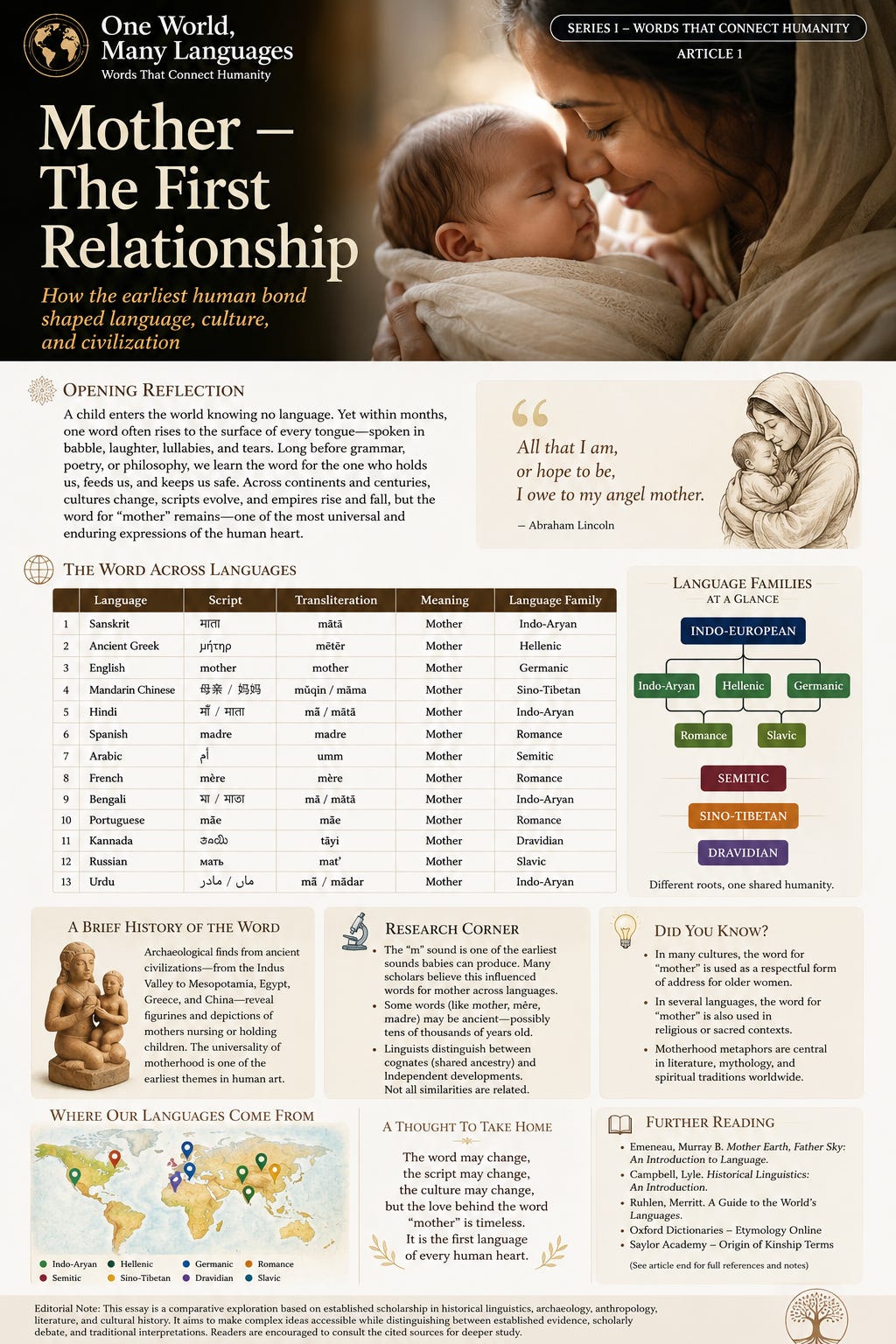
Words That Connect Humanity
A Child’s First World
Every child enters the world without a single spoken word.
There are no alphabets. No grammar. No dictionaries. No national identities. No civilizations.
There is only warmth, touch, sound, and the reassuring presence of another human being.
Long before we learn to read or write, long before we understand history or science, we begin recognizing a voice, a face, and a feeling of safety.
Across continents and across thousands of years, humanity has developed more than 7,000 languages. Their scripts, sounds, and histories are wonderfully different. Yet among this extraordinary diversity, one idea appears everywhere—the person who nurtures, protects, and comforts us.
We call her by many names.
Mātā.
Mētēr.
Mother.
Mā.
Mère.
Madre.
Tāyi.
Umm.
The words are different.
The relationship is universal.
Welcome to Words That Connect Humanity, a series that explores how languages reveal the shared experiences that define us all.
The Word Across Languages
LanguageScriptWordSanskritमाताMātāAncient GreekμήτηρMētērEnglishMotherMotherMandarin Chinese母亲 / 妈妈Mǔqīn / MāmaHindiमाँ / माताMā̃ / MātāSpanishMadreMadreArabicأمUmmFrenchMèreMèreBengaliমা / মাতাMā / MātāPortugueseMãeMãeKannadaತಾಯಿTāyiRussianматьMatʹUrduماں / مادرMā̃ / Mādar
Some of these words resemble one another. Others are completely different. That diversity tells a fascinating story.
Languages such as Sanskrit, Kannada, Ancient Greek, English, Russian, Spanish, French, and Portuguese belong to the Indo-European language family, so many of their words for “mother” share deep historical roots.
Arabic belongs to the Semitic family. Kannada belongs to the Dravidian family. Mandarin Chinese belongs to the Sino-Tibetan family. Their words developed independently, reminding us that while human experiences are universal, languages often evolve along very different paths.
More Than a Parent
The word mother is rarely limited to biology.
Across cultures it also represents:
Love
Protection
Home
Compassion
Memory
Sacrifice
Identity
In Sanskrit literature, Mātā extends beyond the human parent. Rivers are honored as mothers, the Earth is revered as Bhūmi Mātā, and the homeland is often described as a mother deserving care and respect.
Ancient Greek tradition celebrated motherhood through both everyday family life and mythology. Demeter, goddess of agriculture and harvest, embodies maternal care intertwined with the rhythms of nature.
In Chinese culture, the characters 母 (mǔ) and 妈 (mā) express not only family relationships but also respect and affection, reflecting the central role of family in social life.
In Kannada literature, Tāyi carries emotional depth, symbolizing care, sacrifice, and cultural identity. Expressions such as Kannada Tāyi (”Mother Kannada”) personify the language itself as a nurturing presence.
Across civilizations, the word grows into a symbol of care, belonging, and continuity.
Why Do So Many Languages Sound Similar?
One question often surprises people:
Why do so many languages have words like mama, amma, or mā?
The answer is partly biological and partly historical.
Speech development research suggests that the /m/ sound is among the easiest consonants for infants to produce because it requires simply closing the lips while vocalizing—a movement babies naturally make while feeding. Combined with an open vowel such as a, this often results in sounds like ma or mama, which caregivers recognize and reinforce.
Historical linguistics tells another part of the story.
Within the Indo-European language family, words such as Sanskrit mātā, Greek mētēr, Latin mater, and English mother descend from a common ancestral form reconstructed by linguists as *méh₂tēr. Their similarities are therefore not accidental but reflect a shared linguistic heritage.
In unrelated language families, however, similar sounds may arise independently through early child speech rather than common ancestry.
The lesson is an important one:
Not every similarity means languages are related—but not every similarity is merely coincidence either.
A Window into Civilization
Every civilization tells stories about mothers, yet each tradition highlights different qualities.
Some celebrate motherhood as the source of life.
Others emphasize wisdom, sacrifice, or protection.
Many personify the Earth as a mother.
Others describe rivers, languages, or nations using maternal imagery.
These traditions differ in expression, but they reveal a common human instinct: to associate care, continuity, and belonging with the idea of motherhood.
Language preserves these values long after kingdoms disappear and empires fade.
Research Corner
What Scholars Agree On
🟢 Words for “mother” are among the oldest and most stable terms in many languages.
🟢 Similar “mama”-type sounds are common because they are easy for infants to produce.
🟢 Many Indo-European languages preserve historically related forms descended from a common ancestral language.
Where Scholars Continue to Explore
🟡 The balance between biological speech development and inherited linguistic forms in shaping early kinship vocabulary.
🟡 Regional differences in how children first address caregivers.
Understanding these distinctions helps us appreciate both the science of language and the diversity of human cultures.
Did You Know?
The English word mother is historically related to Sanskrit mātā, Ancient Greek mētēr, Latin mater, German Mutter, and Russian matʹ through the Indo-European language family.
In many cultures, the word “mother” extends beyond family to describe rivers, the Earth, languages, and homelands.
Kinship terms are among the most conservative parts of a language, often preserving very old linguistic features.
Why This Matters Today
We live in an age of unprecedented global communication.
Technology allows us to speak across continents in seconds, yet language can still feel like a barrier.
Looking at a single word like mother reminds us that beneath our different scripts, sounds, and traditions lies a remarkably familiar human experience.
We may pronounce the word differently.
We may write it in different scripts.
We may tell different stories.
But the relationship it represents is one of humanity’s oldest shared experiences.
Perhaps that is where understanding begins—not in speaking the same language, but in recognizing the same humanity.
A Thought to Take Home
Every language carries the memory of a civilization.
Every civilization carries the hopes of generations.
And sometimes, the shortest words tell the longest stories.
The word mother is more than a name.
It is one of humanity’s oldest expressions of love, care, and belonging.
Perhaps the language that truly connects us is not found in a dictionary.
Perhaps it is found in the relationships that every language, in its own way, has always tried to describe.
Further Reading
David Crystal — The Cambridge Encyclopedia of Language
Lyle Campbell — Historical Linguistics: An Introduction
Monier-Williams — A Sanskrit–English Dictionary
Liddell & Scott — A Greek–English Lexicon
Oxford English Dictionary (Etymology)
Merriam-Webster Dictionary (Word Origins)
Thank you for reading World Language.
If this essay resonated with you, consider sharing it with someone who enjoys language, history, or culture. In the next article, we’ll explore another foundational human idea and discover what it reveals about the civilizations that shaped our world.
One World. Many Languages. Shared Humanity.